
September 24, 2026 · Bryan M. Rogoff, OD, MBA, MSc, CPHM, FAAO
Back to Basics
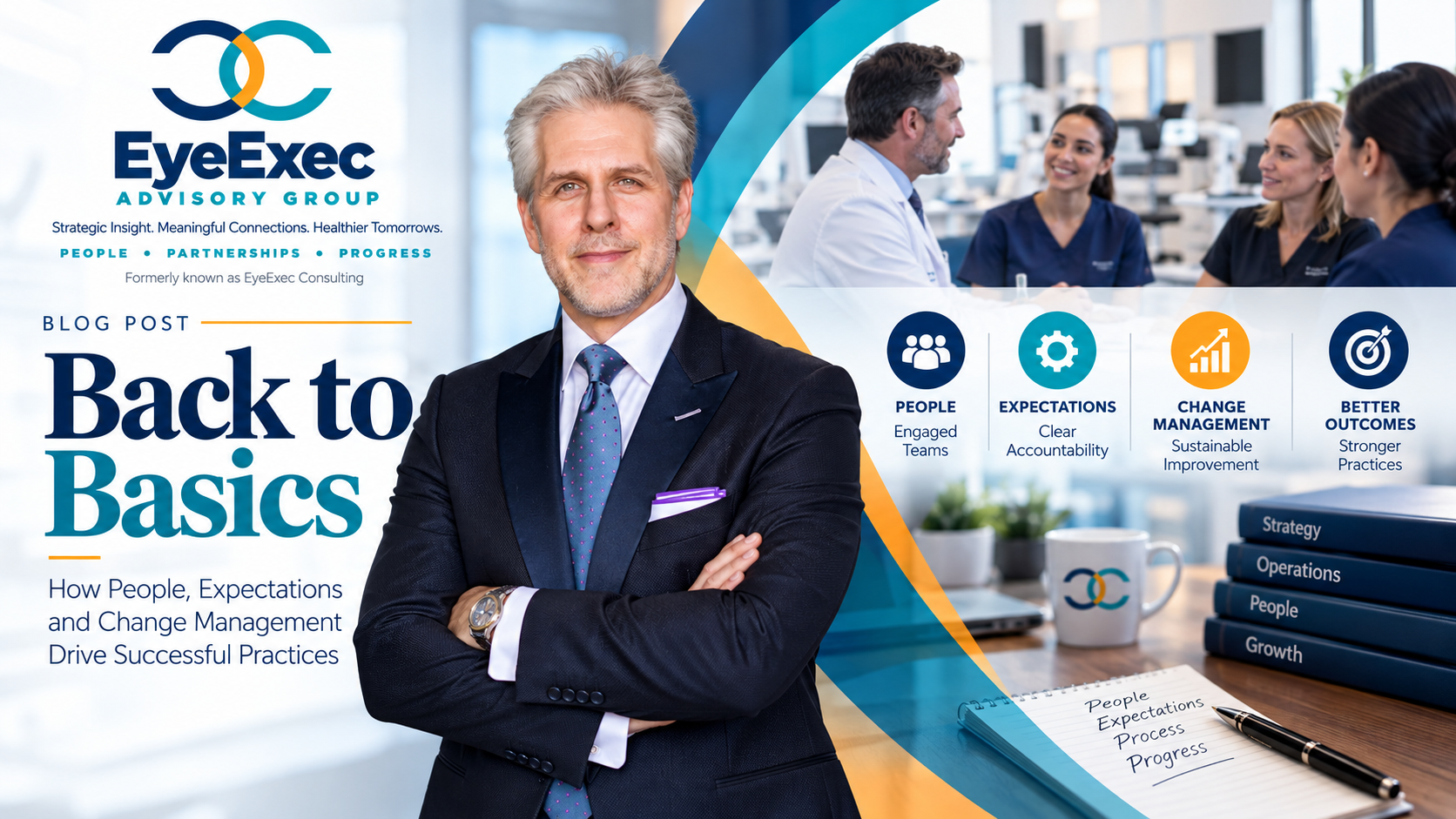
Getting back into consulting and working directly with a new client recently reminded me of something that is easy to forget when you spend years working within large organizations: sometimes the most important business lessons are the simplest ones.
Healthcare practices can invest in new technology, introduce new services, change ownership, redesign workflows, or develop ambitious growth strategies. But ultimately, the success of almost every one of those initiatives comes down to one thing: people and their willingness to embrace change.
This is true in optometry and ophthalmology, but it certainly isn't unique to eye care. The same dynamics exist throughout private healthcare practices.
One of the most valuable things a consultant can do is actually spend time in the practice.
Not just reviewing financial statements, productivity reports, schedules, or other metrics. You need to physically walk through the office. Watch how patients move through the practice. Listen to how employees communicate with one another. Observe how doctors interact with staff and how staff interact with the owner.
You quickly begin to understand the culture of the organization—and sometimes that tells you more than a spreadsheet ever could.
Change Is Usually the Hardest Part
Whether improving an existing practice or transitioning a practice from one owner to another, change management is consistently one of the greatest challenges.
A new owner may immediately see opportunities to improve efficiency, introduce new products or services, change responsibilities, or establish different expectations. But employees—particularly those who have been with a practice for many years—may see those same changes very differently.
“We've always done it this way” can be one of the biggest barriers to progress.
That doesn't necessarily mean employees are unwilling to change. Often, they simply haven't been given enough context about what is changing, why it is changing, and what their role will be going forward.
That's where leadership becomes critical.
Expectations Need to Be Clear
One of the fundamentals I find myself returning to is establishing appropriate boundaries and expectations between owners, doctors, managers, and staff.
Employees should understand what they are responsible for and, equally important, how success will be measured.
If the practice wants to grow a particular service, improve patient retention, increase adoption of a product, improve collections, reduce scheduling gaps, or create a better patient experience, the staff needs to be part of that conversation.
You cannot simply tell people to “do better” or “sell more.”
They need specific, measurable expectations.
In the corporate world, we routinely use SMART goals: Specific, Measurable, Achievable, Relevant, and Time-bound. There is no reason the same discipline shouldn't be applied to private practice.
Instead of saying, “We need to improve this service,” establish what improvement actually means. Define the target. Determine who owns it. Measure progress. Discuss the results. Recognize success and coach where improvement is needed.
That structure creates accountability without creating ambiguity.
Back to Basics
Consulting doesn't always require introducing something revolutionary.
Sometimes the greatest value comes from helping a practice return to the fundamentals: clear roles, appropriate boundaries, measurable expectations, open communication, accountability, and consistent leadership.
This becomes especially important during an ownership transition. A successful transition isn't simply the transfer of a business from one person to another. It is the transition of relationships, expectations, culture, and trust.
The numbers matter. The strategy matters. The technology matters.
But after returning to hands-on consulting, I've been reminded of something even more fundamental:
Before you can change a practice, you have to understand the people who make it work.
And sometimes, moving forward starts by getting back to basics.
Bryan M. Rogoff, OD, MBA, MSc, CPHM, FAAO
Founder & Principal, EyeExec Advisory Group